
Joining Our Going God

I remember once visiting a historic cathedral in New York City. It was a beautiful building, full of art, statuary, and soaring architecture. It felt like a deeply sacred space. Yet as I walked through it, I felt unsettled.

Part of my discomfort came from the commercialization. Hundreds of tourists snapped selfies. Donation boxes seemed to be everywhere. Gaudy bronze penny-press machines flanked the main aisle. It felt a little like Jesus walking through the temple courts.

But at a deeper level, what unsettled me was how little impact the sacred realities that space represented seemed to be having. A few people gathered for Mass, but they kept their heads down and were ushered through gates by security while tourists wandered past. Outside, others lounged or begged for money on the cathedral steps.

Worship was still happening in that place, but it felt strangely disconnected from the world around it. Scripture was read. Psalms were recited. Yet it all seemed to exist apart from the bustling city rather than engaging it.

That image has stayed with me—not because it represented the failure of one parish in Manhattan, but because it reflected a temptation common to Christians of every tradition. We can begin to treat faith as something we gather for rather than something we are sent into. We settle for a faith without mission, a believing without going.

Where does this mindset come from? There are many possible answers, but I believe one of the deepest is a faulty vision of God Himself.

Many people imagine God as ultimately passive. Whether they think of Him as a distant cosmic force, a judge in the sky, or a kindly grandfather figure, they picture Him as largely uninvolved. He sits in heaven, while the primary movement of history is humanity reaching toward Him.

Even churches that affirm God’s activity can subtly fall into this pattern. We speak as though He has done His part and is now waiting for us to do ours. He accomplished salvation through Christ, and now He simply waits while we decide whether to embrace it, proclaim it, or obey it.

Sometimes we even tell the story of Scripture this way. Humanity rebels against God. In His grace, He provides a way back through Jesus. Then He waits on the other side of the chasm while we choose whether to cross the bridge of the cross.

But that is not the story the Bible actually tells.

From the opening chapters of Genesis, God is the One who moves first. Humanity rebels, and immediately God begins pursuing those who have run from Him. We hide, and He comes looking for us.

  • When Adam and Eve sin, God seeks them out, clothes their nakedness, and promises a Redeemer who will crush the serpent’s head.
  • When the nations are scattered at Babel, God immediately calls Abram and promises that through him all the families of the earth will be blessed.
  • When Israel is enslaved in Egypt, God does not merely unlock the prison door. He comes to deliver His people, leading them by a pillar of cloud and fire. He places His own dwelling in the midst of their camp.
  • Again and again, when Israel rebels or wanders, God moves toward them. He raises up judges. He establishes kings. He sends prophets to call His people home.
  • Then, in Jesus, God literally moves into our neighborhood. Before Christ becomes the way for us to come to God, He is Immanuel—God with us.
  • And when the church is formed, believers are sent into the world not to begin God’s work but to join it. God has already prepared a harvest among the nations. He pours out His Spirit, and the earliest Christians continually discover that He has gone before them.

Scripture is, from beginning to end, the story of a missionary God.

He is always moving toward the lost, seeking the wandering, pursuing the broken, planting, watering, preparing, and redeeming. Our calling is not to remain safely inside the house but to go into His fields and gather the harvest He is already growing.

Few truths are more empowering for our missionary calling than this one. We are not trying to persuade a reluctant God to care about the world. We are following a God who is already at work in it. If we want to experience what God is doing, we should certainly gather for worship—but we should also go where He is moving.

That calling touches every part of life. God sends us to our neighbors and coworkers, to the man who collects our trash and the woman who bags our groceries. Wherever people are, God is already pursuing them.

But there is something uniquely encouraging about seeing that same God at work in places far from home. Whether watching lives transformed in prisons, communities served in inner cities, or churches planted among unreached peoples, we are reminded that God’s mission extends to every nation.

That is our hope at CFCI. We often describe our trips with a simple phrase: Go where God is moving. We don’t believe we are bringing God somewhere He has never been. We believe He is already at work, pursuing people with His love, and we have the privilege of joining Him. That is the invitation of mission—and, ultimately, the story of the Bible itself.

September’s Letter from the President

During this last month I took a long road trip with my son Adam, driving from Omaha to Pittsburgh and back. Somewhere along those miles, between conversations about faith, life, and the future, I found myself deeply encouraged. Adam has chosen to dedicate his life to serving Christ and will soon head to the Philippines to minister to university students through a campus ministry.
As a father, I couldn’t be more grateful. As the leader of a missions organization, I couldn’t be more hopeful.

Around the world, I see similar stories unfolding.

Many of our CFCI ministries are investing in children, teenagers, and young adults. Some are supporting youth pastors. Others are discipling students or creating opportunities for young people to encounter Christ and grow in their faith.

Recently, one of our Zimbabwean missionaries attended a leadership training in Kenya with Dare 2 Share, a partner organization. The vision behind the gathering was simple: Every teen, everywhere, hearing the Gospel from a friend.

After receiving training, hundreds of students were sent into nearby communities to share their faith. For many, it was the first time they had ever done so. Imagine the joy of seeing young believers step out in courage, share the hope of Christ, and watch lives be transformed.

The missionary ended his report with these words: “Now we get on the ground and spread the fire.”

I love that phrase. The challenges facing our world are real, but so is the work of God. Across nations and generations, He is raising up young people who are bold in their faith and passionate about His mission.

And that gives me great hope!

Jake Hjemvick
CEO & President of Christ For the City International

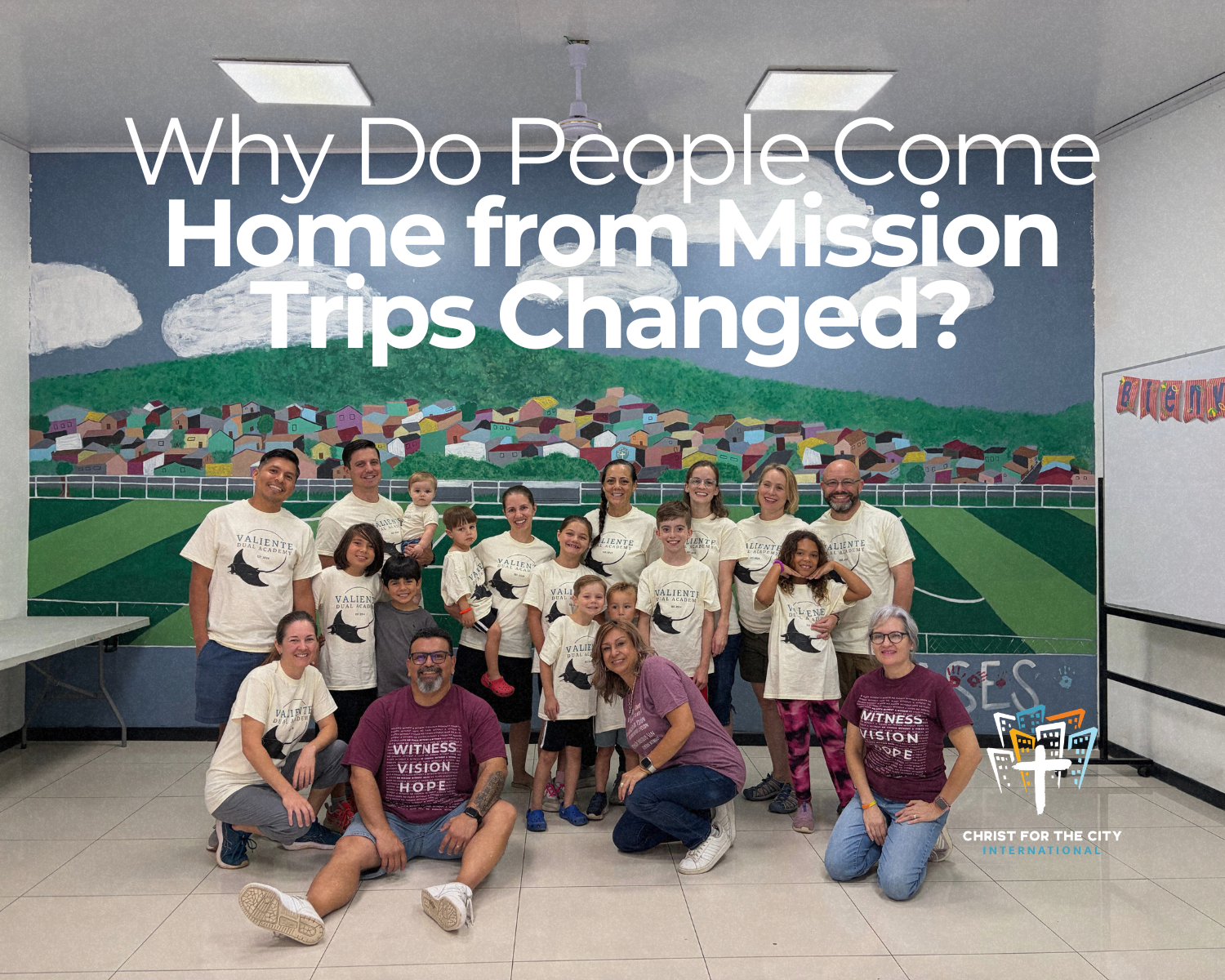
Why Do People Come Home from Mission Trips Changed?

If you’ve ever talked with someone after a mission trip, you’ve probably heard them say, “I went there to serve, but I feel like I received more than I gave.”

At first, that sounds backwards.

Mission trips are about serving others, sharing the love of Jesus, and stepping into the needs of a community. Yet time and time again, people come home talking not only about what God did through them, but about what happened within them.

Why is that?

The truth is, God is just as present in Omaha as He is in Guatemala, Zimbabwe, or anywhere else in the world. He isn’t more available on the mission field than He is in our homes, workplaces, churches, or neighborhoods.

But when we step away from our normal routines, something often shifts in us.

The distractions are quieter.
The schedules are different.
The familiar comforts are gone.
And suddenly we’re paying attention in a new way.

We pray with greater expectancy. We notice people more intentionally. We become more aware of opportunities to love, encourage, serve, and share the hope we’ve found in Christ.

It’s not that God suddenly shows up when we board a plane.
It’s that we’re often more aware of the ways He’s been present all along.

Mission trips have a way of reminding us that we were never meant to do life in our own strength. We encounter situations we can’t control, conversations we didn’t plan for, and moments that invite us to trust God more deeply. In those moments, we’re reminded that ministry isn’t about having all the answers, it’s about learning to recognize and respond to what God is already doing.

Many people leave on a mission trip hoping to impact someone else’s life.

And they do.

Relationships are built. People are encouraged. Hope is shared.

But somewhere along the journey, something begins to change in the heart of the person serving.

Our perspective expands.
Our compassion grows.
Our faith deepens.

We begin to see people the way God sees them.

And perhaps most importantly, we discover that God is already at work in far more places than we realized.

The purpose of a mission trip isn’t simply to go somewhere different. It’s an invitation to join God in what He’s already doing and to learn what it looks like to live with greater awareness of His presence.

Maybe that’s why so many people return home changed.

Not because they found God somewhere far away.

But because they became more aware of His nearness, more attentive to His voice, and more willing to say yes to the invitation He has been extending all along.

And the beautiful thing is this: That invitation doesn’t end when the trip is over.

The same God who is at work across the world is at work in your neighborhood, your workplace, your family, and your everyday life.

The mission field may change your perspective, but it also reminds you that every day is an opportunity to partner with God right where you are.

Maybe all that’s needed is a simple yes.

If you’re ready to explore where God might be inviting you next, visit CFCI Go Trips to learn more about upcoming mission opportunities and ways to serve around the world.

Your Church was Made for Mission: 5 Ways to Partner with Christ For the City International

At Christ For the City International, we believe the Church was never meant to stay inside four walls. From the very beginning, God called His people to live on mission—loving their neighbors, serving their communities, and bringing the hope of Jesus to the nations.

Churches play a vital role in that mission.

Whether your congregation is passionate about going, giving, praying, or mobilizing others, there are meaningful ways to partner with what God is doing through CFCI around the world.

Here are five simple ways your church can be part of the story.


1. Go on a Mission Trip

One of the most powerful ways a church can engage in missions is by going together.

Mission trips allow youth groups, college ministries, young adults, small groups, families, and entire congregations to step outside their normal rhythms and serve alongside local ministries around the world.

Through Urban Plunge trips in U.S. cities and Global Teams serving internationally, churches can:

• Share the Gospel
• Serve practical needs in communities
• Encourage and support local leaders
• Grow in faith and unity as a team

There’s something powerful about taking what God is doing inside the church walls and living it out together in the world.


2. Give to the Mission

Missions move forward because of faithful generosity.

When churches give to the vision of Christ For the City International, they help sustain ministry happening every day in cities and communities across the globe.

Your giving fuels discipleship, leadership development, outreach, and compassionate service through our international bases.

Our vision remains bold:

No place without a witness.
No church without a vision.
No person without hope.

And we continue to believe God is inviting us to help create environments where 1 million lives can be forever changed through the ministry of CFCI.

When your church gives, you’re investing in transformation that reaches far beyond what any one team or trip could accomplish.

Become a financial partner!


3. Pray for the Mission

Prayer is one of the most powerful ways your church can partner in missions.

Across the world, CFCI teams are serving communities, discipling believers, and sharing the hope of Jesus in places that often require courage, perseverance, and faith.

Your prayers provide encouragement, protection, and spiritual covering for missionaries, national leaders, and the people they serve.

Consider setting aside time to pray for:

• CFCI missionaries and global staff
• The communities being served
• Open hearts to the Gospel
• Future leaders being raised up

When the Church prays, God moves.


4. Mobilize Your People

Sometimes the greatest impact a church can have is simply inviting people into the mission.

You can help mobilize others by:

• Sharing mission trip opportunities with your congregation
• Encouraging students and young adults to explore serving abroad
• Highlighting stories of transformation from the field
• Creating moments where missions becomes part of the conversation

Many people feel called to serve—but they just need someone to point them toward the opportunity.

Your church could be the place where that calling begins.


5. Build a Long-Term Partnership

Missions are most powerful when relationships grow over time.

Some churches choose to partner more deeply with CFCI by building an ongoing relationship with one of our ministry bases or returning regularly to serve in the same location.

Over time, these partnerships allow churches to:

• Encourage and support local leaders
• See long-term impact in communities
• Send teams year after year
• Watch God work in powerful ways

What begins as a single trip can grow into a lasting Kingdom partnership.


The Invitation

The mission of God is bigger than any one church or organization. But when we work together, the impact multiplies.

Whether your church chooses to go, give, pray, mobilize, or partner, you have a role to play in bringing the hope of Jesus to cities and communities around the world.

And together, we believe it’s possible to see 1 million lives forever changed.

Ready to explore the next step for your church?

Visit cfci.org/go to learn more about mission opportunities.

Fasting Before You Go: Making Space for God Before Your Mission Trip

It’s Lent.

A season of slowing down.
Of surrender.
Of making room.

And if you’re preparing for a mission trip — whether across the street or across the world — there may not be a better time to lean in.

Before you pack your bag, raise support, or finalize logistics… consider fasting.

Not to prove something.
Not to be intense.
Not to check a spiritual box.

But to make space.

Why Fast Before a Mission Trip?

Mission trips aren’t powered by strategy alone. They’re sustained by dependence.

Fasting is one of the clearest ways we say:

“God, I need You more than I need comfort.”

Throughout Scripture, fasting was connected to:

  • Clarity

  • Repentance

  • Breakthrough

  • Preparation

  • Spiritual authority

Even Jesus fasted before stepping fully into public ministry (see Gospel of Matthew 4:1–11).

If fasting mattered before He stepped into His calling, it might matter before we step into ours too.


What Is Fasting — Really?

Fasting isn’t about spiritual performance.

It’s about removing something normal in your life to become more aware of your need for God.

It’s creating intentional hunger — physical or otherwise — so your heart becomes more attentive.

And during Lent especially, fasting reminds us:

We are not self-sufficient.
We are sustained by Him.


How to Fast (Without Making It Weird)

You don’t have to go extreme to go deep.

Here’s a simple framework:

1. Ask God What to Fast

One meal?
A full day?
Social media?
Caffeine?
Sugar?
Streaming?

Start with prayer. This is about obedience, not comparison.


2. Set Your Focus

Don’t just remove something — replace it with intention.

Ask:

  • Am I praying for boldness?

  • Unity on our team?

  • Protection?

  • Open hearts?

  • Personal surrender?

Write it down. Be specific.


3. Replace the Time

If you skip a meal, use that time to pray.
If you give up social media, use that scroll-time for Scripture.

Reflect on passages like:

  • Psalm 69:10,13

  • Joel 2:12

  • Gospel of Matthew 6:16–18

Fasting without prayer is just dieting.
Fasting with prayer is dependence.


4. Expect Discomfort

You might get a headache.
You might feel irritable.
You might really miss your coffee.

That discomfort is not failure — it’s awareness.

Every time you feel it, let it become a whisper:

“God, I need You.”

And don’t be surprised if distractions increase. Spiritual focus often invites resistance. Stay grounded. Stay steady.


5. Ease Back In

If you fast from food, reintroduce it slowly. Your body will thank you.

Fasting is spiritual — but it’s also physical wisdom.


Before You Begin

Pause for a moment.

  • What might God be inviting you to surrender?

  • What time can you intentionally set apart for Him?

  • What are you hoping to hear?

  • What are you afraid He might say?

Lent is not about deprivation.
It’s about preparation.

And a mission trip is not just something you do.
It’s something God does in you.


Living Sent Starts in the Secret Place

Before public ministry comes private surrender.

Before outreach comes intimacy.

If you’re preparing for an Urban Plunge or a Global Team, don’t just prepare your suitcase.

Prepare your spirit.

Make space.
Lean in.
Let Him shape you before He sends you.

Ready to step into what God is inviting you into?

Learn more about upcoming Urban Plunges and Global Teams at:

👉 cfci.org/go

PLEASE NOTE: Per IRS guidelines all contributions to Christ for the City International are tax deductible to the full extent permitted by law and made with the understanding that Christ for the City International has complete discretion and control over the use of all donated funds.

Copyright © 2022 Christ For the City International. All Rights Reserved.


Join our Mailing list!

Get all latest news from CFCI


  • contact a Missions director

Call us at 888-526-7551

  • Contact Us
Call us at 402-592-8332
5855 North 90th Street | Omaha, NE 68134