
Growing a Vision for Missions: The Five Stages

Many Christians long to see their local church grow in its vision for missions. Whether they are leaders or members, they desire a deeper passion—for themselves and for their church—for God’s every-tribe-and-tongue work in the world. Yet while that desire may be present, many struggle to know how to help their faith communities grow in that vision.

Part of CFCI’s mission is partnering with local churches to help them engage in God’s global mission. One helpful way to think about that journey is to break it into five stages. Here they are—and how we can help.

1. Knowing

Every journey begins with understanding some foundational truths. God’s people need to know things like:

  • The gospel is not meant to end with us; it is something we receive and then share with others.
  • The kingdom of God is advancing, and we are invited to offer our lives in service to that work.
  • God’s mission is global, encompassing people from every tribe, tongue, and nation.
  • The Great Commission is the mission of the Church.

Teaching these truths is essential. If people do not understand them, the later stages will never take root. Most churches, however, do teach these things. The challenge is that many Christians can repeat the information without allowing it to shape their hearts and lives.

Why does that happen?

2. Doing

In the Christian life, knowing leads to doing. Until truth is put into practice, it has not yet fully taken root. When it comes to missions, one of the best ways to understand God’s heart for the nations is to participate in His work.

At the same time, growth happens in stages. Jesus spent three years preparing His disciples before sending them out. Paul likewise spent years growing in faith and understanding after his conversion. Yet throughout that process, he was already participating in God’s mission.

So what might those first steps look like?

Begin by making a concrete plan to join God’s work in your local community or a neighboring one. Learn to serve, witness, and love people in your own cultural context before stepping into another.

This is the vision behind CFCI’s Urban Plunge program. It creates opportunities for churches to engage with the spiritual and physical needs of a nearby urban center. Along the way, participants are challenged to deepen their own walk with Jesus as well.

3. Going

While local ministry is invaluable, few experiences help believers catch a vision for God’s global mission like a short-term mission trip.

These trips do two important things:

  • They call us out of our comfort zones. As we take larger steps of faith into unfamiliar situations, our trust in God grows as we experience His faithfulness.
  • They introduce us to the wider Church. Serving and worshiping alongside indigenous believers and leaders is often transformative. We discover that God—and His people—are far bigger and more beautiful than we imagined.

CFCI facilitates these experiences through our Global Trips. These trips provide opportunities for teams to serve alongside local ministries around the world, witnessing what God is doing and contributing in meaningful ways to that work.

4. Partnering

It is one thing to experience the global Church. It is another thing entirely to develop lasting relationships within it.

Cross-cultural partnerships make the communion of the saints visible and tangible. They remind us that we belong to one body, united in Christ despite differences of language, culture, and geography.

One of the most exciting aspects of CFCI’s Global Trips is the opportunity they create for ongoing partnerships. Teams can return to the same ministry locations year after year, reconnecting with familiar faces and witnessing firsthand how God continues to work. We are always excited to help cultivate and strengthen these long-term relationships.

5. Sending

While every church can know, do, go, and partner, our prayer is that God would also call some individuals to devote their lives to cross-cultural ministry.

This calling is not for everyone, but it is something every church should celebrate, support, and pray for.

CFCI provides a unique environment for those exploring such a calling. Our Global Ambassadors program offers training, support, and opportunities for longer-term service experiences lasting up to a year. We can also serve as a sending organization for those whom God leads into long-term missionary service.

Wherever your church may be on this journey, it is worth asking: What is the next step?

How might God be inviting your church to grow into a deeper vision for His mission?

And wherever that next step leads, know that we at CFCI are here to help.
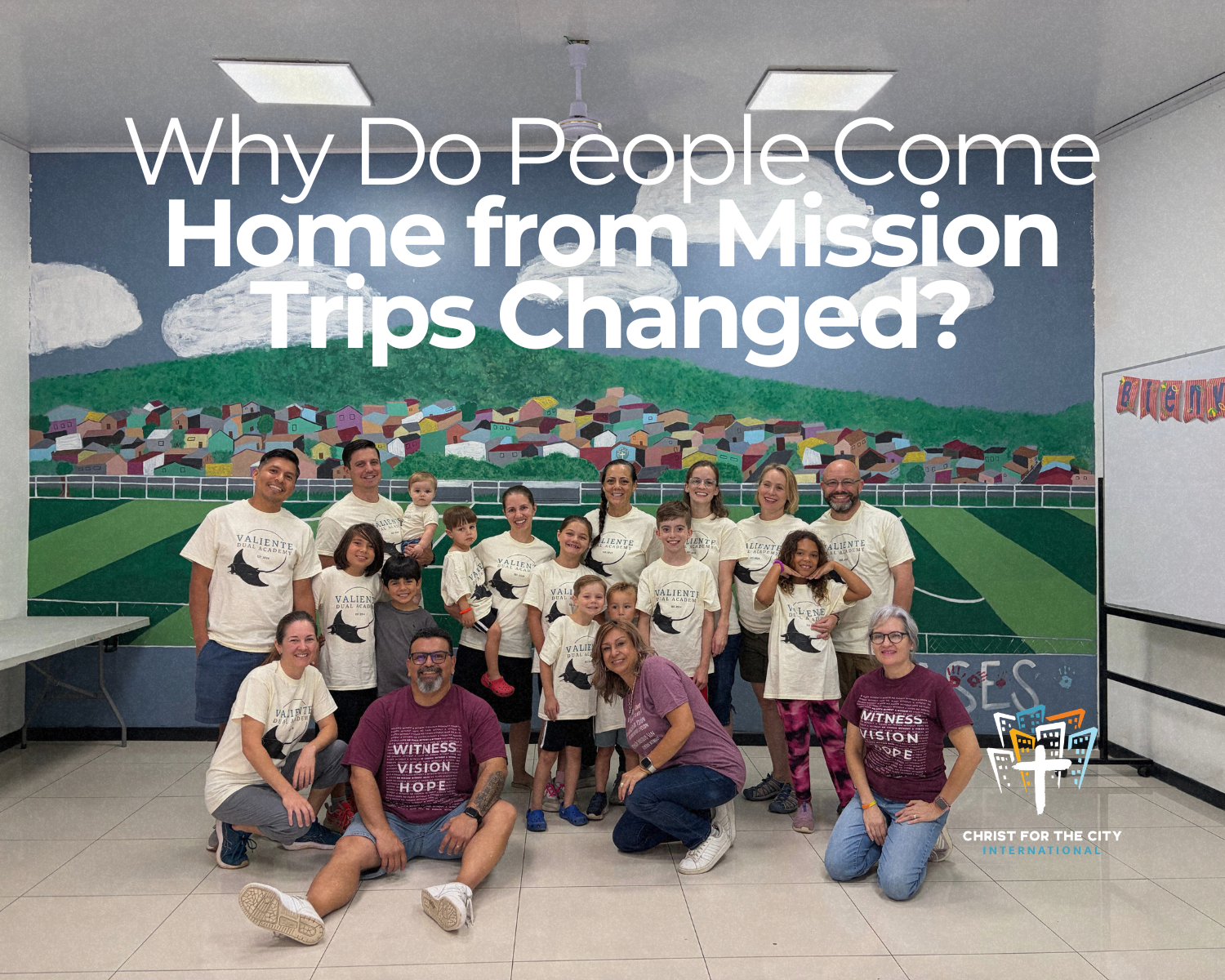
Why Do People Come Home from Mission Trips Changed?

If you’ve ever talked with someone after a mission trip, you’ve probably heard them say, “I went there to serve, but I feel like I received more than I gave.”

At first, that sounds backwards.

Mission trips are about serving others, sharing the love of Jesus, and stepping into the needs of a community. Yet time and time again, people come home talking not only about what God did through them, but about what happened within them.

Why is that?

The truth is, God is just as present in Omaha as He is in Guatemala, Zimbabwe, or anywhere else in the world. He isn’t more available on the mission field than He is in our homes, workplaces, churches, or neighborhoods.

But when we step away from our normal routines, something often shifts in us.

The distractions are quieter.
The schedules are different.
The familiar comforts are gone.
And suddenly we’re paying attention in a new way.

We pray with greater expectancy. We notice people more intentionally. We become more aware of opportunities to love, encourage, serve, and share the hope we’ve found in Christ.

It’s not that God suddenly shows up when we board a plane.
It’s that we’re often more aware of the ways He’s been present all along.

Mission trips have a way of reminding us that we were never meant to do life in our own strength. We encounter situations we can’t control, conversations we didn’t plan for, and moments that invite us to trust God more deeply. In those moments, we’re reminded that ministry isn’t about having all the answers, it’s about learning to recognize and respond to what God is already doing.

Many people leave on a mission trip hoping to impact someone else’s life.

And they do.

Relationships are built. People are encouraged. Hope is shared.

But somewhere along the journey, something begins to change in the heart of the person serving.

Our perspective expands.
Our compassion grows.
Our faith deepens.

We begin to see people the way God sees them.

And perhaps most importantly, we discover that God is already at work in far more places than we realized.

The purpose of a mission trip isn’t simply to go somewhere different. It’s an invitation to join God in what He’s already doing and to learn what it looks like to live with greater awareness of His presence.

Maybe that’s why so many people return home changed.

Not because they found God somewhere far away.

But because they became more aware of His nearness, more attentive to His voice, and more willing to say yes to the invitation He has been extending all along.

And the beautiful thing is this: That invitation doesn’t end when the trip is over.

The same God who is at work across the world is at work in your neighborhood, your workplace, your family, and your everyday life.

The mission field may change your perspective, but it also reminds you that every day is an opportunity to partner with God right where you are.

Maybe all that’s needed is a simple yes.

If you’re ready to explore where God might be inviting you next, visit CFCI Go Trips to learn more about upcoming mission opportunities and ways to serve around the world.

What We Mean By Holistic Missions

There is sometimes a tension in missions between two approaches.

One is centered on what we might call a spiritual mission. It looks at the world and sees people who need to be reconciled to God, so it focuses primarily on evangelism and helping people become followers of Jesus.

The other is centered on what we might call a physical mission. It looks at the world and sees the ways sin has broken people’s lives and circumstances, then focuses on bringing healing, justice, and restoration to those areas of brokenness.

Advocates of both approaches can be suspicious of the other side—and both have compelling biblical arguments. Those emphasizing spiritual ministry might ask, “For what does it profit a man to gain the whole world and forfeit his soul?” (Mark 8:36). Those emphasizing physical care might respond, “If a brother or sister is poorly clothed and lacking in daily food, and one of you says to them, ‘Go in peace, be warmed and filled,’ without giving them the things needed for the body, what good is that?” (James 2:15–16).

So how do we decide? Which side is right?

Like many apparent conflicts in the Christian life, the way forward is not choosing one side over the other but recognizing the truth in both.

One of CFCI’s core commitments is holistic missions. Through our network of ministries around the world, we seek to address both spiritual and practical needs through discipleship, youth outreach, medical care, education, community development, and more. We do this because we believe these ministries belong together.

We see this integrated approach in the ministry of Jesus Himself. The words of the kingdom and the works of the kingdom—the proclamation of good news and the restoration of what sin has broken—were inseparable in His mission. As Matthew writes, “And Jesus went throughout all the cities and villages, teaching in their synagogues and proclaiming the gospel of the kingdom and healing every disease and every affliction” (Matthew 9:35).

Sharing the gospel is essential to God’s mission. We are called to bear witness to the death and resurrection of Jesus and invite people into new life through Him. Without this inward transformation, our outward efforts can never fully address humanity’s deepest need. Furthermore, the good works Christians are called to pursue flow from the gospel itself. We care for physical needs because the Holy Spirit is reshaping our hearts and priorities.

At the same time, the good news we proclaim should be accompanied by lives and ministries that embody that good news. We are not called merely to make converts but to make disciples—people whose lives are increasingly transformed to reflect God’s character and purposes. And because we proclaim the gospel of a kingdom, our work should reflect the justice, compassion, and love of the King who reigns over it.

Far from being opposed, the spiritual and physical dimensions of mission work exist in beautiful harmony. This is exactly what we see in CFCI ministries around the world. Our hope is whole people being wholly restored by Jesus. Through evangelism and Bible study, visiting prisoners and empowering the helpless, the gospel is being shared in both word and deed. As a result, lives are being transformed and the kingdom of God is advancing.

Make Lasting Memories with Family Mission Trips

A 12-year-old boy stood in front of a soccer school in El Salvador, gripping his notes with sweaty hands.

Dozens of kids stared back at him.

Moments earlier, they had been laughing, joking, and chasing a soccer ball. Now they were listening closely.

He took a breath and shared a simple message.

“I used to think I had to be perfect for God to love me,” he said. “But I’m learning that He just wants me to keep giving Him my best.”

That was it.

No polished sermon.
No fancy words.

And somehow, every kid there could relate and connect.

“I stood in the back watching him talk to those kids and thought, ‘I would have missed this version of my son if we hadn’t come,’” Lindsay said. “I was watching him step into faith and compassion in a way I hadn’t seen before.”

A few days earlier, Lindsay watched her son teach local teenagers how to play chess.

Somewhere between explaining pawns and bishops, he connected the game to God’s kingdom, how every piece has a purpose and every role matters.

Later that same week, he quietly prayed for a woman inside her tiny home after hearing her share about her sick son.

And through every moment, Lindsay kept coming back to the same thought: I would have missed this version of my son if we hadn’t gone.

That’s the power of families serving together on mission trips.

Yes, communities are impacted.
Yes, churches are encouraged.
Yes, practical needs are met.

But something sacred also happens inside the family itself.

Over the last few years, Christ For the City International has seen more families saying yes to missions together, and the impact reaches far beyond what most people expect.

“The people we serve aren’t only seeing a husband or wife—they’re seeing the entire dynamic of a family,” Josue, one of our missionaries and coordinators in Costa Rica, said.

For many children in the communities we serve, that picture is rare.

Some have never seen a healthy family working together.
Some have never watched parents serve side by side.
Some don’t know what it looks like for a family to laugh together, pray together, and love others together.

So when families arrive on the mission field, it communicates something powerful before a single word is translated.

And children respond in ways that consistently surprise even the adults.

They connect quickly—through soccer, crafts, music, games, and laughter. Language barriers fade as relationships form naturally.

More than observers, children from visiting families often become active participants in ministry.

They pray for others.
They engage with local children.
They serve in practical ways.
And they often step into moments of ministry with a boldness that grows throughout the trip.

In the process, something important happens: They begin to realize that God can use them right now.

Not someday when they are older.
Not once they feel more prepared.
But in the present.

At the same time, parents often witness something just as meaningful—the unfolding of their children’s faith in real time.

Mission trips have a way of removing families from routine and placing them into environments where faith becomes practical.

Moments where a child prays for someone they just met.
Moments where joy is witnessed in places of lack.
Moments where compassion becomes lived experience instead of abstract belief.

These experiences often leave a lasting imprint long after returning home.

And while many assume mission trips require large teams or complex logistics, the reality is far simpler.

Six people is enough to form a team, which means families do not have to wait until everything aligns perfectly.

It might be two families from the same church.
It might be close friends who have talked about serving together.
It might be a small group ready for something deeper.

The invitation is simple: go together.

Serve together.
Experience together.
Grow together.

Because mission trips do more than impact the communities being served.

They shape the families who go.

And often, they shape the next generation in ways that cannot be fully understood until they return home changed.

Ready to bring your family—or another family alongside you—on a mission trip?

Visit cfci.org/go to learn more about upcoming opportunities and how to begin planning together.

Short-Term Missions as Formation

From the beginning, Jesus’ followers have been called into a worldwide mission. As Luke records Jesus’ final words to his disciples:

“But you will receive power when the Holy Spirit has come upon you, and you will be my witnesses in Jerusalem and in all Judea and Samaria, and to the end of the earth.” (Acts 1:8)

We are both the fruit of that witness (imagine the gospel traveling from Jerusalem all the way to a continent the disciples didn’t even know existed!) and participants in the same calling. While not all of us are called to go to the ends of the earth, all of us are called to support that vision.

Some people struggle with the idea of short-term mission trips. They ask important questions such as:

  • How much good can I really do in a week?
  • Aren’t people within a culture better equipped to share the gospel than I am?
  • Isn’t this an inefficient use of resources and money?

Each of these questions contains truths that we need to consider carefully in how we approach mission. However, they also reflect an assumption: that the purpose of mission is only about what we accomplish at our destination during a short visit.

The idea of short-term mission trips actually originates with Jesus. We read in Luke 9:

“And he called the twelve together and gave them power and authority over all demons and to cure diseases, and he sent them out to proclaim the kingdom of God and to heal.” (Luke 9:1–2)

The disciples go, and when they return, Jesus gives them further instruction. Then He sends out a larger group of seventy-two disciples to do the same thing (Luke 10). When they return, their hearts are filled with excitement over what God has done through them.

“The seventy-two returned with joy, saying, ‘Lord, even the demons are subject to us in your name!’” (Luke 10:17)

Why did Jesus send out these disciples?

They didn’t yet have the full story to share—Jesus’ cross and resurrection were still in the future. They didn’t yet have the full power to proclaim it—the Holy Spirit had not yet been given at Pentecost. So what was the purpose of these short-term trips?

The answer is found in Acts 1. By the time the disciples received their calling to be Christ’s witnesses to the ends of the earth, these earlier journeys had already taught them what that meant. They were formed to be lifelong witnesses through seasons of focused witness.

I remember voicing questions about short-term missions to an older friend who had spent much of his life on the mission field. He agreed that the concerns were valid, but then said, “Let me tell you how I sensed a call to missions.”

He described a short-term trip he took as a college student—an experience that completely transformed his understanding of God’s mission. It put him on the path that had defined his life Then he added, “I don’t know many missionaries who didn’t catch their vision on a short-term mission trip.”

At CFCI, there are many reasons we support short-term trips, both in the United States and around the world. We seek to conduct them in ways that thoughtfully address the concerns mentioned above. There is real value in the work our teams accomplish.

But we also support them because we believe in their transformative power for those who go. Mission is formation. Going out—even for a short time—teaches us how to live as witnesses for Jesus wherever He has placed us. And sometimes, it opens our hearts to a new and unexpected calling that changes the course of our lives.

June Letter from the President

I’ve seen a pattern over the years in Scripture, in my own life, and through the ministry of CFCI around the world. God often calls us forward before we feel ready. He invites us to trust Him in uncertainty, to take steps of obedience without having all the answers, and to follow Him even when fear is still present. 

We see this lived out every day through our missionaries. They step into unfamiliar places, build relationships across cultures, and engage complex challenges. They don’t do it because it’s easy, but because they believe God has called them. And in that obedience, something deeper happens. They don’t just participate in God’s work; they grow in their understanding of His faithfulness. They discover greater clarity in their purpose and experience a deeper walk with Him. 

This is not just the story of missionaries. It is the invitation extended to every follower of Christ. Each of us faces moments where we must choose between what feels comfortable and what God is asking of us. In those moments, obedience becomes the pathway not only to impact, but to knowing God more fully. 

This message of faithful obedience is one that we’ll be leaning into in a special way this fall at our Fueling Transformation Gala in Omaha on November 10, 2026. We are honored to welcome Kent Chevalier as our featured speaker. As the author of Do It Afraid and chaplain for the Pittsburgh Steelers, Kent brings a powerful combination of personal story and biblical insight, challenging each of us to trust God beyond what feels comfortable and to step forward in faithful obedience.  

It will be an evening not only to celebrate what God is doing through CFCI around the world, but also to be encouraged and equipped in our own walk with Him. I hope you can join us! 

Fundraising Is Ministry (Even If It Doesn’t Feel Like It)

If we’re honest, most of us don’t naturally associate fundraising with something sacred.

It can feel awkward. Transactional. Like we’re asking for something instead of offering something.

But what if that’s not actually what’s happening?

In A Spirituality of Fundraising, Henri J. M. Nouwen gently challenges that tension. He reframes fundraising not as a necessary burden, but as a form of ministry—an invitation into something deeper.

Not a transaction.
A relationship.

Not pressure.
An opportunity.

Not about money.
About participation in God’s work.

An Invitation, Not an Ask

At its core, fundraising is simply this: inviting people to be part of what God is already doing.

It’s easy to think we’re asking someone to give something up.
But in reality, we’re inviting them to step into something eternal.

When we share stories of transformation—lives changed, hope restored, communities renewed—we’re not selling a cause.

We’re opening a door.

And when someone walks through it, they’re not just writing a check.

They’re saying yes to being part of the story God is writing.

Why It Feels So Hard

If fundraising feels uncomfortable, it’s often because we’ve believed something untrue about it.

Maybe we’ve thought:

  • “I’m bothering people.”
  • “They’re going to say no.”
  • “This is about money, not ministry.”

But Nouwen reminds us that these thoughts miss the heart of it.

Fundraising is grounded in the belief that:

  • God is already at work.
  • People want to live with purpose and generosity.
  • We get to connect the two.

That’s not pressure—that’s partnership.

Ministry Happens on Both Sides

One of the most beautiful ideas Nouwen shares is that fundraising doesn’t just bless the ministry—it blesses the giver.

Because giving is never just about the resource.
It’s about transformation.

When someone gives, they’re aligning their heart with what matters most.
They’re choosing faith over fear.
They’re investing in something that lasts.

That’s spiritual formation.

That’s discipleship.

That’s ministry.

And sometimes, this invitation isn’t just something we extend—it’s something we step into ourselves.

For Those Preparing to Go

And sometimes, this invitation isn’t just something we extend—it’s something we step into ourselves.

If you’re getting ready to step onto a Global Team, this might be the part that feels the hardest.

Raising support can feel vulnerable.

You might wonder:

  • What if people say no?
  • What if I don’t raise enough?
  • What if this feels… uncomfortable?

But what if fundraising isn’t standing on the outside, asking people to send you?

What if it’s standing in the middle of what God is doing—and inviting others to come with you?

You’re not asking people to fund a trip.

You’re inviting them to take part in ministry they may never physically step into—but can still be deeply part of.

So We Keep Inviting

At Christ For the City International, we’ve seen this firsthand.

Every trip taken.
Every ministry launched.
Every life impacted.

None of it happens alone.

It happens because people say yes—yes to going, yes to serving, and yes to giving.

So we keep inviting.

Because fundraising was never just about provision.

It’s about participation in the work of God.

Whether you’re called to go or to give, there’s a place for you in this story.

👉 Explore Global Teams
👉 Become a financial partner

What Happens When a Family Says “Yes” to Missions Together?

For Roeland, Anna, and their daughter Diana, missions wasn’t just a personal calling.

It became a shared “yes.”

After participating in several short-term mission trips, the family from the Netherlands began sensing God leading them into something deeper. They wanted to go beyond a brief outreach experience and spend a longer season serving wherever God opened the door.

That journey eventually led them to Zimbabwe through Christ For the City International’s Global Ambassador program.

“We were convinced that we had to go to Zimbabwe,” they shared. “And because of that, we had complete confidence that God would show us what we were supposed to do there.”

What began as online research and conversations with CFCI slowly became confirmation after confirmation that Zimbabwe was where they were meant to go. The doors kept opening. God kept guiding.

And eventually, they stepped through those doors together.

Missions as a Family

For many people, the idea of serving on a mission trip as a family can feel intimidating.

What about the logistics?
What about finances?
What about comfort zones, schedules, or uncertainty?

But for Roeland, Anna, and Diana, serving together became one of the most meaningful parts of the experience.

“It was a wonderful opportunity to serve and to be able to do so together as a family,” they said.

And while Diana is an adult with previous experience doing development work in Africa, their story still reflects something powerful: family mission trips matter at every stage of life.

Families don’t have to look one specific way to serve together.

Sometimes it’s parents and young children.
Sometimes it’s siblings.
Sometimes it’s adult children joining their parents in ministry.
Sometimes it’s an entire church family stepping into missions side by side.

What matters most is simply being willing to say yes together.

Their family even launched a project called Source of Hope, making themselves available for months at a time to bring practical help, encouragement, and hope to people in Zimbabwe.

Learning Patience and Trust

Like many missionaries and short-term teams experience, the beginning wasn’t about jumping immediately into projects and activity.

It was about slowing down.

Listening.
Learning.
Adjusting.

“For Diana, the beginning took some getting used to,” they shared. “There was first a period of discovery and visiting all the projects. Her patience was put to the test.”

But in that waiting, clarity came.

Diana eventually found herself deeply involved at a boys’ orphanage, serving through her background as a social worker and investing personally in the lives of the children there.

For the entire family, one of the greatest lessons God has been teaching them is patience and dependence on Him.

“You want to get started and get to work right away,” they said. “But first we had to take time to settle in and get our bearings.”

They also shared that one of the hardest parts of becoming Global Ambassadors was trusting God financially.

“It was quite a big step to choose something while not having the full finances for it.”

Yet even there, God has continued to provide.

The Moments That Change You

Mission trips are rarely remembered because of itineraries or schedules.

They’re remembered because of people.

For Roeland, one unforgettable moment happened after inviting two boys from an orphanage to a men’s breakfast gathering.

One of the boys later said:
“I feel alive.”

“That really resonated with me,” Roeland shared. “He experienced the Holy Spirit within him, and he can carry that with him despite his circumstances.”

For Anna, it was serving at a ministry called Healing with Horses, where children with physical and intellectual disabilities are given the opportunity to ride horses.

“There was a girl there who was so enthusiastic about being allowed to ride again,” Anna said. “Her eyes sparkled with joy.”

For Diana, one of the most impactful moments came during a home visit in the slums of Bulawayo, where they met a mother raising her four children while also caring for two adopted children — including one child abandoned because of severe disabilities.

“A harrowing situation,” Diana shared, “but also a miraculous choice by a mother who can barely make ends meet in poverty, yet still takes on the care of another person’s child.”

These are the kinds of moments where you don’t just see the needs of the world — you encounter the heart of Jesus in a way that leaves fingerprints on your heart forever.

You Don’t Have to Do Everything Alone

One of the beautiful things their family discovered is that missions together doesn’t mean everyone has to do the exact same thing.

“You don’t have to do everything together,” they explained. “It’s important to let each other play to your strengths.”

That’s true for families.
It’s true for teams.
It’s true for churches.

Every person brings something unique.

Some teach.
Some build relationships.
Some organize.
Some pray.
Some lead worship.
Some encourage.
Some simply show up willing to serve.

And God uses all of it.

A Shared Mission

When asked what they would say to families or teams considering missions together, their answer was simple: “It starts with opening yourself up to the Lord.”

They encouraged people not to wait until they feel perfectly prepared, but to simply begin somewhere — even with a short-term trip.

“It brings you closer together because you have a shared goal and build memories together. It is a unique experience.”

That’s the beauty of missions.

Whether you go as a family, a group of friends, a church team, a youth group, or as an individual joining others on the field, God uses shared experiences to transform hearts.

Not just the people being served.
But the people serving too.

Because sometimes the greatest transformation happens when ordinary people simply make themselves available to God.

And then watch what He does next.

Interested in serving on a mission trip, Urban Plunge, or becoming a Global Ambassador?

Visit www.cfci.org/go to explore opportunities to serve around the world.

“Go for it. You won’t regret it.”

When Josh Fenton from the United Kingdom took a career break, he knew it was time to fulfill a lifelong dream—serving on an extended mission trip. After completing a ministry training program, he joined Christ For the City International as a Global Ambassador and spent several months serving in Zimbabwe.

“There wasn’t really a typical day,” Josh said. “Some days were spent helping with renovations at Emthunzini Wethemba, other days with children at Isaiah’s Home, or in rural and street ministry. Every day was an opportunity to grow.”

One of his favorite moments came on his final day—a bonfire night with the boys at the children’s home. “We cooked, laughed, sang around the fire, and celebrated everything we’d done together. It was the perfect ending.”

Josh says the experience changed him deeply. “My biggest takeaway was the power of unconditional love—how we can be vessels for God to show that to a stranger.”

From mentoring youth to praying with Evans, a young man who started a chicken business after being paralyzed in an accident, Josh saw firsthand how God brings hope in the hardest places.

For anyone considering becoming a Global Ambassador, Josh says:

It’s one thing to read about the life of love that Jesus led—but it’s another thing to live it every day. Go for it. You won’t regret it.

Josh discovered that unconditional love can change a life—and you can too.
Whether you’re ready to serve on a Global Team, lead a group, join an Urban Plunge, or take your next step in missions, there’s a place for you to go.

Explore opportunities to live the Gospel in action → www.cfci.org/go

Your Church was Made for Mission: 5 Ways to Partner with Christ For the City International

At Christ For the City International, we believe the Church was never meant to stay inside four walls. From the very beginning, God called His people to live on mission—loving their neighbors, serving their communities, and bringing the hope of Jesus to the nations.

Churches play a vital role in that mission.

Whether your congregation is passionate about going, giving, praying, or mobilizing others, there are meaningful ways to partner with what God is doing through CFCI around the world.

Here are five simple ways your church can be part of the story.


1. Go on a Mission Trip

One of the most powerful ways a church can engage in missions is by going together.

Mission trips allow youth groups, college ministries, young adults, small groups, families, and entire congregations to step outside their normal rhythms and serve alongside local ministries around the world.

Through Urban Plunge trips in U.S. cities and Global Teams serving internationally, churches can:

• Share the Gospel
• Serve practical needs in communities
• Encourage and support local leaders
• Grow in faith and unity as a team

There’s something powerful about taking what God is doing inside the church walls and living it out together in the world.


2. Give to the Mission

Missions move forward because of faithful generosity.

When churches give to the vision of Christ For the City International, they help sustain ministry happening every day in cities and communities across the globe.

Your giving fuels discipleship, leadership development, outreach, and compassionate service through our international bases.

Our vision remains bold:

No place without a witness.
No church without a vision.
No person without hope.

And we continue to believe God is inviting us to help create environments where 1 million lives can be forever changed through the ministry of CFCI.

When your church gives, you’re investing in transformation that reaches far beyond what any one team or trip could accomplish.

Become a financial partner!


3. Pray for the Mission

Prayer is one of the most powerful ways your church can partner in missions.

Across the world, CFCI teams are serving communities, discipling believers, and sharing the hope of Jesus in places that often require courage, perseverance, and faith.

Your prayers provide encouragement, protection, and spiritual covering for missionaries, national leaders, and the people they serve.

Consider setting aside time to pray for:

• CFCI missionaries and global staff
• The communities being served
• Open hearts to the Gospel
• Future leaders being raised up

When the Church prays, God moves.


4. Mobilize Your People

Sometimes the greatest impact a church can have is simply inviting people into the mission.

You can help mobilize others by:

• Sharing mission trip opportunities with your congregation
• Encouraging students and young adults to explore serving abroad
• Highlighting stories of transformation from the field
• Creating moments where missions becomes part of the conversation

Many people feel called to serve—but they just need someone to point them toward the opportunity.

Your church could be the place where that calling begins.


5. Build a Long-Term Partnership

Missions are most powerful when relationships grow over time.

Some churches choose to partner more deeply with CFCI by building an ongoing relationship with one of our ministry bases or returning regularly to serve in the same location.

Over time, these partnerships allow churches to:

• Encourage and support local leaders
• See long-term impact in communities
• Send teams year after year
• Watch God work in powerful ways

What begins as a single trip can grow into a lasting Kingdom partnership.


The Invitation

The mission of God is bigger than any one church or organization. But when we work together, the impact multiplies.

Whether your church chooses to go, give, pray, mobilize, or partner, you have a role to play in bringing the hope of Jesus to cities and communities around the world.

And together, we believe it’s possible to see 1 million lives forever changed.

Ready to explore the next step for your church?

Visit cfci.org/go to learn more about mission opportunities.

PLEASE NOTE: Per IRS guidelines all contributions to Christ for the City International are tax deductible to the full extent permitted by law and made with the understanding that Christ for the City International has complete discretion and control over the use of all donated funds.

Copyright © 2022 Christ For the City International. All Rights Reserved.


Join our Mailing list!

Get all latest news from CFCI


  • contact a Missions director

Call us at 888-526-7551

  • Contact Us
Call us at 402-592-8332
5855 North 90th Street | Omaha, NE 68134